
This week’s Torah portion covers Deuteronomy 11:26 to 16:17. The Torah portion is called Re’eh, which is the imperative to look. It begins, “See, I am setting before you today a blessing and a curse” (11:26).
Until now, many of the laws of the covenant have seemed abstract. They were instructions for purging idols from the lands Israel would conquer, and for setting boundaries in the territory they would settle. Only now are those calls to action on the verge of becoming visible realities.
Moses has stopped reminiscing about the last forty years. He is now reiterating the Torah’s law code. In Chapters 5–6, he reminded the people of the theological reasons they committed themselves to the one true God and agreed to follow him wholeheartedly. For the next fifteen chapters, Moses lays out the statutes that will govern the twelve tribes once they settle in the land of Canaan.
Most of the decrees cover the everyday life of the Israelites and are familiar from previous Torah portions. These include dietary laws, protecting the poor, tithing, and keeping the pilgrimage feasts. The Deuteronomist insists on the importance of observing all the divine commandments. The people are not to add to the law or take away from it.
Ancestral Memory
Moses speaks to the assembly as if they are already familiar with the land on the other side of the Jordan. He says, “As you know, they are beyond the Jordan, some distance to the west, in the land of the Canaanites who live in the Arabah, opposite Gilgal, beside the oak of Moreh” (11:30).
They know these landmarks. These places were already part of their sacred oral family history. When Abraham first entered Canaan centuries earlier, God appeared to him by the oak of Moreh at Shechem. Abraham built an altar on that spot (Genesis 12:6–7). When Jacob returned to Canaan from Paddan-aram, he bought a plot of land at Shechem and pitched his tent there (Genesis 33:18–19). Remember that the Israelites have been carrying the bones of Joseph ever since they left Egypt. Their plan is to bury him in the family plot at Shechem (Joshua 24:32).
Moses connects their upcoming conquest with their patriarchal roots. He reminds the people that crossing the Jordan is not an entry into strange, foreign territory. It is a homecoming to the valley where God first made his covenant with Abraham.
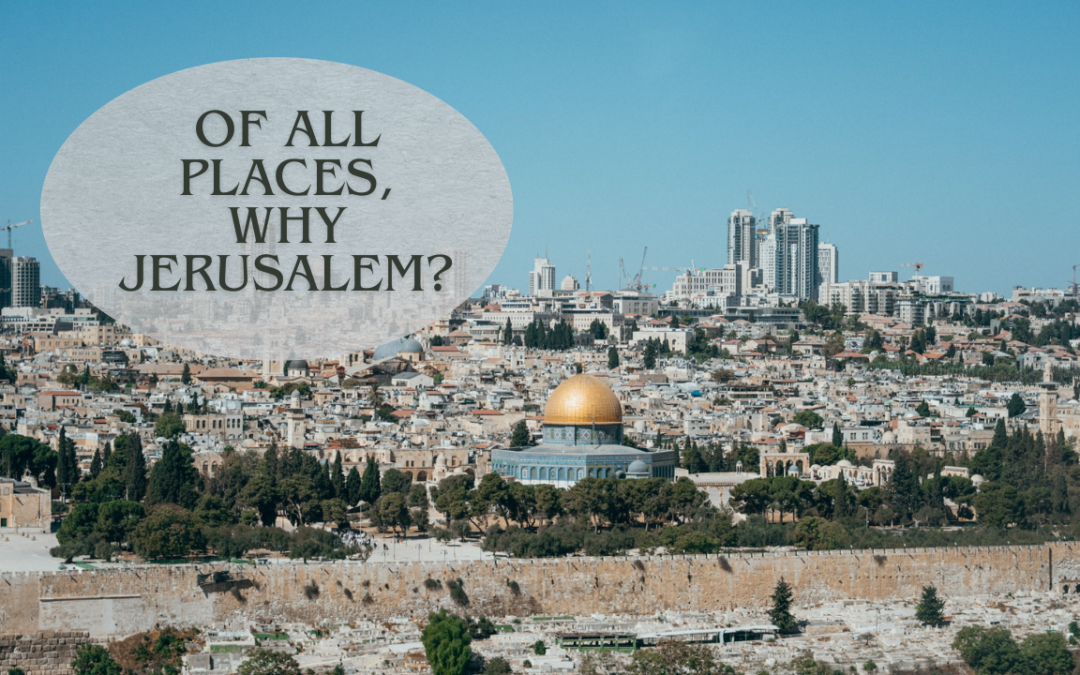
Jerusalem
Deuteronomy 12 looks to a future day when the Tabernacle no longer needs to be portable. Until now, God has moved his cloud of presence from camp to camp, following the Israelites in their forty-year journey. God promises that they are entering a place of rest from their wanderings and from surrounding enemies. When they are living in relative safety, God desires his presence to also have a place of rest.
Subscribe to Bible Fiber on Youtube or wherever you listen to your podcasts.
This Torah portion introduces a new reform in the sacrificial life of all Israelites. Moses says,
But you shall seek the place that the Lord your God will choose out of all your tribes as his habitation to put his name there. You shall go there, bringing there your burnt offerings and your sacrifices, your tithes and your donations, your votive gifts, your freewill offerings, and the firstlings of your herds and flocks. (12:5–6)
The phrase “the place that the Lord your God will choose” (or its slight Hebrew variations, such as “the place the Lord will choose to put his name”) appears 21 times in Deuteronomy. The geographic location of God’s sanctuary is not named outright. It remains anonymous. However, the book clearly establishes the principle of centralization. Moses says, “Be careful not to sacrifice your burnt offerings anywhere you please. Offer them only at the place the Lord will choose in one of your tribes, and there observe everything I command you” (12:13−14).
When the people enter the land, God will restrict sacrificial worship to one place. The kings and prophets will hold up Deuteronomy’s call for centralized worship as the divine protection of Jerusalem. However, Jerusalem was not the first place God put his name after they settled in the land.
From Joshua’s death to the time of the prophet Samuel, Shiloh was Israel’s first spiritual capital. For over three hundred years during the period of the judges, Shiloh housed the priestly class and the Tabernacle. The people came to celebrate the pilgrimage festivals at Shiloh. The offerings and sacrifices were conducted at Shiloh.
Only once King David established Israel’s united monarchy did Jerusalem come into the picture as the spiritual and political capital for all twelve tribes. King David eagerly brought the Ark of the Covenant to the newly occupied royal capital, Jerusalem. David’s son Solomon constructed the First Temple in Jerusalem and transported the ritual vessels into the Temple’s inner sanctum. The entire process from Moses’s proclamation in Deuteronomy to Solomon’s dedication ceremony took nearly 450 years. Only then did Jerusalem finally became the dwelling place for God to set his name.
The Problem of Decentralization
Though Deuteronomy is absolute on the point of centralization, once the Israelites settled in Canaan, they popped up open-air shrines and altars all over the land. This practice continued even after Solomon constructed the First Temple and the entire nation watched the glory of the Lord fill the sanctuary (1 Kings 8:10–11).
Archaeological excavations in Israel and Judah confirm the scale of the problem. Excavators have uncovered ancient altars and shrines from the ninth to the sixth centuries BCE on hilltops, at city gates, along ridges, and in wooded clearings. Notable discoveries include a Judean fortress temple at Tel Arad, a dismantled horned altar at Tel Beersheba, and an altar room built directly into the city gate at Lachish. These high places were often former Canaanite sites of worship—the exact locations God commanded Israel to demolish (12:2–3). Instead of destroying them, the people gave in to temptation. They offered sacrifices and burned incense to the false gods of their neighbors.
In the book of Kings, the narrator judges Israelite monarchs as righteous or evil largely by how they handled these regional shrines. Many kings who were otherwise faithful to God receive a recurring criticism: “nevertheless the high places were not taken away” (1 Kings 15:14; 22:43). Only two Judean kings—Hezekiah and Josiah—receive full commendation for dismantling the rural high places and centralizing worship in Jerusalem (2 Kings 18:4; 23:8–20).
The biblical prophets also attacked the high places. Hosea referred to them as “the sin of Israel” and likened the practice to spiritual adultery. He warned, “The high places of Aven, the sin of Israel, shall be destroyed. Thorn and thistle shall grow up on their altars” (Hosea 10:8)
The people had abandoned the one true God to lust after idols. By the days of Jeremiah, the regional altars were blatantly contaminated with pagan rituals. Jeremiah indicted the nation for worshiping “on every high hill and under every green tree” (Jeremiah 2:20). He condemned the high places of Baal built in the Valley of Ben-hinnom (Jeremiah 19:5).
Josiah
It was not until the reforms of King Josiah in 622 BCE that the rural high places were finally abolished. Under Josiah’s rule, Jerusalem became the sole authorized site for sacrificial worship and national devotion.
What inspired Josiah’s religious revolution? During the eighteenth year of his reign, the king ordered the restoration of the Jerusalem temple. While workers cleared decades of neglect and repaired the sanctuary, the high priest Hilkiah discovered what 2 Kings calls “the book of the law” (22:8).
The royal secretary read the scroll aloud to Josiah. As he listened, he was convicted because the nation was not keeping many of the covenant stipulations. The young king tore his clothes in grief and repentance (2 Kings 22:11). Josiah realized that Judah’s idolatry and scattered shrines had violated God’s law for generations. First, he consulted the prophetess Huldah; then he gathered the elders of Judah and Jerusalem. He read the scroll to the assembly and led the nation in a public renewal of their covenant with God (2 Kings 23:2–3).
Josiah then launched the most sweeping religious purge in Israel’s history. He dismantled the network of regional shrines that had operated for centuries. He desecrated the high places from Geba in the north to Beersheba in the south so they could never be used for worship again (2 Kings 23:8). He removed the priests from the rural towns and brought them to live in Jerusalem. He even marched into the ruined territory of the former northern kingdom and demolished the ancient altar at Bethel (2 Kings 23:15).
Most biblical scholars believe the scroll that the priest found during temple renovations was the book of Deuteronomy—or at least its core legal section, along with the blessings and curses. No other book of the Torah places such emphasis on the necessity of only worshipping in the one place God chooses. That explains why Josiah was laser-focused on purging any substitute sites.
Also, 2 Kings refers to the scroll as “the book of the covenant” (23:2) and “the book of the law” (22:8). These titles are how Deuteronomy refers to itself (29:21; 30:10).
Furthermore, after clearing the land of idols, Josiah commanded the people to keep the Passover to the Lord as prescribed in this book of the covenant (2 Kings 23:21). For the first time, the entire nation journeyed to Jerusalem to observe the feast at a single sanctuary. This national pilgrimage fulfills the Passover legislation of Deuteronomy 16:1–8. It forbids sacrificing the Passover lamb at home and requires it to be celebrated at the chosen place.
Moses delivered the speeches of Deuteronomy almost eight centuries earlier. It had been three centuries since Solomon dedicated the temple. Yet, God, in his perfect timing, ensured that his covenant found its way back to a king who had a sensitive heart for the things of God. We can not obey God’s word if it is not in front of us. We can not be changed by it if we don’t have receptive hearts. We cannot be mobilized by it if we don’t agree as a nation that it takes precedence over everything else. Josiah’s legacy also gives us hope that an earnest revival may always be around the corner.
That’s it for this week. If you would like to get the study questions that go with the reading, please visit our website at www.thejerusalemconnection.us
Shabbat Shalom
Study Questions
- The Centralization of Worship and National Unity (Deuteronomy 12)
Moses commands the Israelites to dismantle all Canaanite shrines and restrict sacrificial worship to “the place that the Lord your God will choose” (12:5). Why was it necessary for Israel to leave behind the ancient Near Eastern practice of local, hilltop shrines? How did traveling to a single national sanctuary help protect the twelve tribes from idolatry and prevent them from splintering into rival political factions?
- Economic Justice and Care for the Vulnerable (Deuteronomy 14:22–15:18)
In his instructions for the second tithe, the sabbatical debt release, and the freeing of servants, Moses repeatedly centers the law on the marginalized. He commands the people to generously provide for the Levite, the stranger, the orphan, and the widow. What do these economic commandments reveal about God’s standard for a righteous society? How does the reminder of Israel’s past slavery in Egypt shape the way they are commanded to treat the poor?
- The Architecture of Collective Joy (Deuteronomy 16:1–17)
When describing the three great pilgrimage festivals—the Passover, the Festival of Weeks, and the Festival of Booths—Moses repeatedly commands the Israelites to rejoice before the Lord together as a nation. How does gathering at a central sanctuary to celebrate shared historical deliverance change an individual’s faith into a shared national identity?